Foreign policy needs evaluation

Foreign policy needs evaluation

Published in the Financial Express on February 24, 2019

Since the foreign policy of a country is the first line of defence, therefore, further evaluation of the policy needs to be done in view of the emerging global scenario. Competing interests of two emerging powers in Asia need to be assessed in the interest of Bangladesh, because the country is sandwiched between the two: China and India.

Geographically, Bangladesh is located on three sides of India and it also borders Myanmar with the Bay of Bengal to the south. But the distance between Bangladesh and China is not that far either. Bangladesh’s close-door neighbour India is trying to flex its economic and political muscles in South Asia, apart from beyond its corridor while China in Far East did not keep quite either. China is bent upon becoming a global military and economic power. China turns out to be the second largest economy of the world by now. In fact, Bangladesh is sandwiched between two big neighbours. Therefore, Bangladesh should play an equidistant policy between two giant neighbours. There is no need to have hobnobbing relations between the two neighbours. Unfortunately, Bangladesh has no card in hand to resolve some vital issues that Bangladesh is confronted with India.

Uday Bhaskar, an analyst with South Asia Monitor, holds the opinion that “Prime Minister Sheikh Hasina has been more receptive to India’s overtures so it’s easier to realise India’s objectives.” Recently the government of Bangladesh has provided an opportunity for India to reach out to the North-Eastern region through a narrow and tenuous land corridor. In fact, Arunachal Pradesh, one of the seven landlocked Indian states, has become a contentious issue between China and India.

There is no second opinion that water is vitally important to lower riparian Bangladesh indeed. As of now, Bangladesh is being deprived of the due share of water from the Ganges, Brahmaputra and Teesta in particular. During the monsoon period Bangladesh is at the receiving end, because sluice gates are opened by India on their dams. The BBC reported in September of 2000 that emerging releases from at least four dams in West Bengal added to floods across the border into Bangladesh. As a result, Bangladesh was flooded losing agricultural products that forced Bangladesh to import a substantial amount of food grains putting pressure on its balance of payment. While serving in the Bangladesh embassy in Germany as Charge d’ affaires in 1998 we faced a critical situation in Bangladesh which witnessed the worst flooding in living memory. This writer mobilised opinions in the government and private sector of Germany to assist the Bangladesh government in mitigating the disaster. The German government provided ten million Euros while water purifying machines were flown to Dhaka WASA by courtesy of the Biman Bangladesh Airlines. The private sector in Germany provided baby food and medicine as well.

As of now, there is no resolution in sight to the problem of sharing water of the Teesta and Feni rivers, although Prime Minister Narendra Modi during his maiden visit to Bangladesh on June 07 2015 pledged a fair solution to the Teesta and Feni water sharing. He said, “Water sharing is, above all, a human issue as it affects the life and livelihood of the people.” Absence of the due share of water during the lean period has caused enormous ecological damage to Bangladesh. It is high time that both Bangladesh and India make all-out efforts to resolve the water sharing problems for the benefit of both countries.

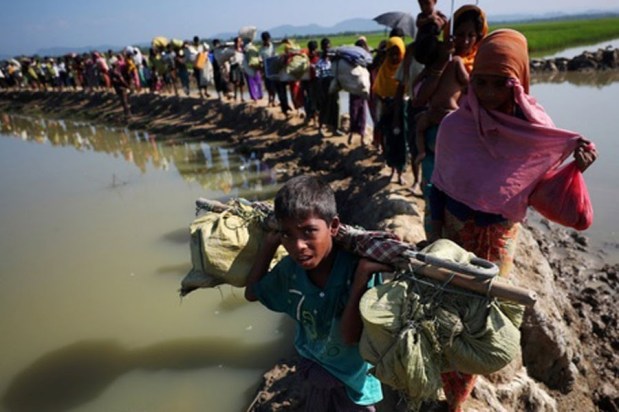
Since Bangladesh has been confronting a man-made disaster with the influx of Rohingya refugees since 2017, Bangladesh should press both India and China vigorously to put pressure on the Myanmar administration to take them back and resettle them as their citizens. Both India and China have their stake in Myanmar. Curiously enough to note, both China and India have invested heavily in the Rakhine state of Myanmar. Refugees from Myanmar in Bangladesh, if the issue is not resolved peacefully, would likely create a breeding ground for terrorism and cutting of trees for using fuel would likely be a catastrophe ecologically.

Although Bangladesh has been acclaimed for success on the economic front and the UN committee for development policy declared that Bangladesh would likely graduate from the LDC status to a developing country by 2024, it has been termed 149th least corrupt nation out of 175 countries, according to the 2018 corruption perception index of the Transparency International.

This being the situation as of now no amount of diplomacy, including economic diplomacy will be fruitful, unless basic conditions in Bangladesh radically improve.

Mohammad Amjad Hossain, retired diplomat from Bangladesh and former President of Toastmaster International club of America, writes from Virginia .

An appraisal of the Trump administration

An appraisal of the Trump administration

Published in the Financial Express on January 4, 2019

Since assuming presidency on January 20, 2017 of the United States of America, the oldest democracy and a global leader in the world, Donald Trump has been unlike any other president in the history of the US. He has constantly referred to the biggest names in news media as ‘fake news’. He has ignored numerous, authentic investigative reports by powerful intelligence agencies of USA.

The patience of Western leaders with his antics seem to be thinning as was reflected during his visit to France to mark the 100th anniversary of the end of World War 1 in November of last year. On arrival, President Trump picked up a quarrel with French President Emmanuel Macron about a piece of garbled press translation, which said Macron wanted a European army as protection against the USA. In fact, Macron is reported to have said such a force would reduce Europe’s reliance on USA. Macron criticised President Trump’s “America First” politics in his speech as he called it “a betrayal of patriotism”.

On November 10, 2018, President Trump also scrapped a planned visit to Aisne-Marne American Cemetery and Memorial for American soldiers who had died during World War 1 in France. The French President and German Chancellor Angela Merkel paid their respects to the war heroes together while Russian President Vladimir Putin paid respects to the fallen heroes alone on the day. The next day, following criticism back home, President Trump paid tribute at Suresnes American Cemetery and Memorial in Paris. He was quick to blame the cancellation of the previous day’s trip on his Secret Service.

In January of last year, Chinese President Xi Jinping turned out to be a global leader while speaking about free trade concept at the World Economic forum in Davos, Switzerland. His stance was well-received by the rich and powerful business magnates and experts as well. It is interesting to note that Canada, a close neighbour of USA, joined Chinese-floated regional Development bank in 2015 while Australia, UK, Germany and France were among the founding members of the bank. Regional Development Bank is likely undermining the authority of the World Bank and the International Monetary Fund established after World War II by the United States.

Japan, a close ally of the United States since the Second World War, and Europe agreed on a free trade deal as an alternative to the Trans-Pacific Partnership floated by President Obama. But President Trump unceremoniously abandoned it. President Trump also pulled out of the Paris Climate Treaty when his administration warned of devastating impacts following climate change and the Iran nuclear deal-two international pacts that European leaders had worked very hard on.

  President Trump has never missed an opportunity to criticise NATO members for failing to spend enough on their militaries. He also shared with Russian President Vladimir Putin that NATO was an obsolete organisation. Following the NATO Summit in Brussels from July 11 till 12, 2018, USA Today’s editorial on July 16 pointed out that the US President’s “truculent attacks on close friends risk serious damage to the greatest alliance America has ever known-to the great delight of Russian President Vladimir Putin who wants to weaken and splinter the west.”

At a press conference on July 16, 2018, following a one-to-one meeting with Putin in Helsinki, Trump told the world that he continues to harbour doubts that Russia interfered in the 2016 US presidential election. He argued that the USA is as much at fault as Russia for “tattering relations between two superpowers”. Trump’s claims came under question after Special Counsel Robert Mueller’s investigations revealed explicit connections that Trump had with Russia before the 2016 US presidential election, through a flurry of bombshell court filings in the first week of December 2018.

While conducting foreign relations, President Trump announced on December 23 that the USA will pull out its troops from Syria. The move will give Russia and Iran free rein in the Middle East. Earlier, his decision to move the US embassy from Tel Aviv to Jerusalem in violation of international law also received criticism from leaders from around the world. He was also rebuked by bipartisan lawmakers for siding with Saudi Arabia following the killing of a Saudi journalist at the Saudi consulate in Istanbul in October of 2018.

Internally, President Trump is pushing for sweeping changes to US immigration. He is planning to close down the visa lottery system and make citizenship difficult for legal immigrants in the USA. He still plans to build a big wall around the US-Mexico border to stop the entry of illegal immigrants. He also banned entry of immigrants into USA from countries like Iran, Libya, Somalia, Syria, Yemen and travellers from North Korea and certain government officials from Venezuela. Facing a growing wave of national outrage, President Trump signed an executive order on June 20, 2018 to halt his administration’s policy of separating migrant families detained at the southern border.

It is interesting to note that as many as 37 officials, including three Chiefs of Staff, have either resigned or been fired from the Trump administration. His first Secretary of State Rex W. Tillerson was removed following disagreement with President on some international issues, including the Middle East. Trump’s Defence Secretary James Mattis also quit in December. Trump immediately assigned Patrick Shanahan as Acting Defence Secretary.

In December of 2018, Trump shut down the Federal administration as Congress is not okaying funds of around $ 5 billion required to build the wall on the US-Mexico border. Incoming Speaker of the House Nancy Pelosi and Minority leader in the Senate Chuck Schumer said to the media on December 31, 2018 that if leader of the Senate Republican Mitch McConnell and senate republicans refuse to support the spending bill, then they are complicit with President Trump at continuing the Trump shutdown. In the process, said Pelosi and Schumer, the Republicans at the senate are holding the health and safety of the American people and workers pay-cheques hostage.

Also, in December, Trump made secret trips to US bases in Iraq to exchange Christmas greetings with American soldiers. In the process, he exposed covert Navy SEAL deployment. During the visit, Trump did not meet any Iraqi leaders. This angered them to the point that they demanded US troops leave Iraq as well.

According to the Washington Post, over 7,000 false or misleading claims have been made by President Trump during his two years as President. By and large, the situation in the United States of America is not at all healthy under Donald Trump’s presidency.

Mohammad Amjad Hossain is a retired diplomat from Bangladesh.

Silk road project of China vis-a-vis Bangladesh

unnamed (2)

Published in the Financial Express on November 12, 2018

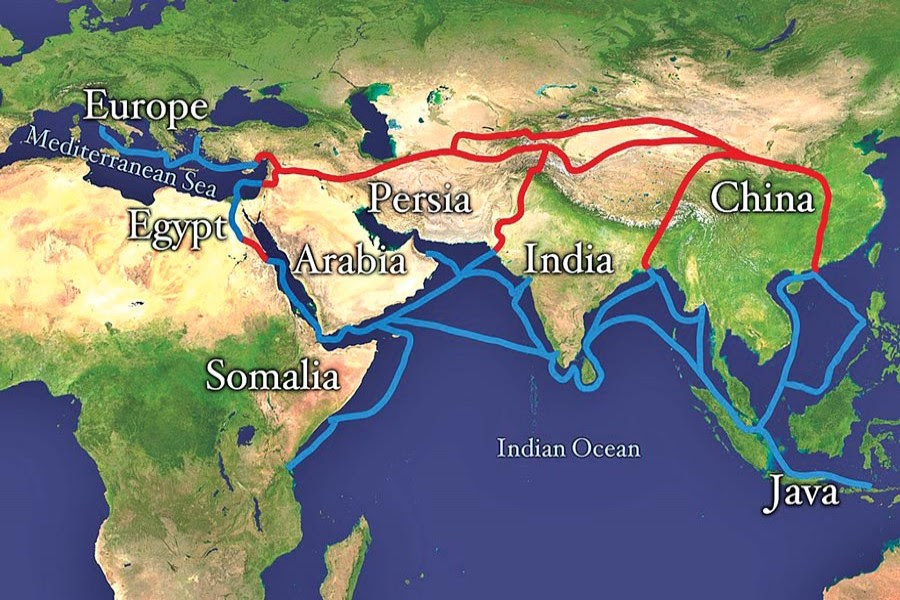
The People’s Republic of China has emerged a leading economic power house in the world in the 21st century thanks to it’s the Belt and Road initiative, a signature project of President Xi Jinping. President Xi Jinping’s Belt and Road initiative in fact is the revival of ancient Chinese Silk Road and Trade which got going during the period of Han dynasty from 207BCE (Before Common Era) to 220 BC (Before Christ). At the initial stage the Han dynasty through explorer Ambassador at large, Ziang Qian, expanded the Silk route in Central Asia.

Trade through the Silk route actually played a significant part in establishing civilisation of China. Chinese Buddhist monk Fa Xian, Hui Zi and Hui Da came to ancient Bengal during the fifth century of Han dynasty to learn Buddhist scriptures. Ancient Bengal was also a place the Chinese trade ships sailed to.

During Song and Yuan dynasties Chinese foreign trade further developed. Large quantities of Chinese silk and porcelain were shipped to India, Sri Lanka and Bengal.

In fact, trade had expanded through navigational routes to South and East Asia and East Africa from 1405 to 1433 during the Ming dynasty. Admiral Zheng He, a Chinese Muslim (Cheng Ho) – mariner, explorer and diplomat – had made seven voyages during his lifetime. Zheng He earned appreciation of Emperor Yongle of the Ming dynasty. During the Ming dynasty there were frequent exchanges of envoys between China and Bengal. In 1408 Sultan Ghiyasuddin Azam Shah dispatched an envoy to establish relations with China. The envoy was accorded warm reception by the central government of the Ming dynasty. In 1415 the government of the Ming dynasty dispatched Hou Xian as an envoy to visit Suvarnogram, now Sonargaon near Dhaka, with credentials from Chinese emperor Zhu Di. While calling on the Sultan, the Chinese envoy presented the Queen and the Ministers of Suvarnogram with generous gifts from the Chinese emperor. Zheng He’s voyage team carried from China things including embroidery umbrellas, silk and Satin, porcelain, camphor, gold, silver, copper, etc. Zheng He’s voyage team visited Ceylon, Calicut, the Maldives, Cochin, Koyamyadi and Bengal in 1430. Zheng He did not visit Bengal but his envoy Hong Bao paid a visit to Chattogram and Sonargaon by small boats from Sumatra and presented the Chinese emperor’s imperial manifesto. This writer was associated with a group of journalists of China Pictorial during their visit in 1993 to publish a special supplement on the visit of Zheng He to this part of the world. Journalists from China Pictorial visited Chattogram, Sonargaon and met Chairman of Bangladesh Parjatan Corporation to know about expedition of Zheng He to this part of the world. All arrangements were made by this writer. The team was led by Madam Bian Youfen, Deputy Director of China Pictorial. A special supplement was published on Zheng He voyages in 1994.

From Han to Tang and Ming dynasties there had been trade between China and all South Asian parts plus Central Asia. Chinese silk, silk cloth, paper, Chinese porcelain were very much liked by peoples of this region. As a matter of fact, Chinese beautiful porcelain was preserved at a small museum of Lalbagh Fort in Dhaka which this writer noticed in mid 60’s. UNESCO designated the Chang’ an-Tian Shan corridor of the Silk route as a world heritage site.

China has been emerging economic power house in the world in the twenty first century from an opium-addicted nation in the nineteenth century. It was introduced by the imperial British Raj of East India Company in 1825 by supplying opium and raw cotton in exchange for tea, porcelain and silk.

In 1793, China was known for sophisticated culture and rich history. In 1839 Qing emperor ordered destruction of the large supply of opium stored in China. Commissioner Lin Zexu undertook an expedition to destroy illicit opium and detained the entire foreign community in Guangzhou which in fact led to an “Opium war” between the Chinese and the imperial British. The Chinese lost the war and were compelled to sign the Treaty of Nanjing in 1842. Under this treaty China ceded the Island of Hong Kong to the British while opened five ports to British residence. This treaty was humiliation to China. The treaty was unequal in nature. The Island of Hong Kong was handed over to China on 1st July of 1997 ending 156 years of rule by the British.

The National Committee of the Chinese People’s Political Consultative Conference held in Beijing in June 2017, however, emphasised an anti-corruption campaign in China and building a moderately prosperous society while deepening reform and advancing rule of law and strictly governing the party. China’s economy is targeting a reasonable range of growth between 6.0 and 7.0 per cent.

China President Xi Jinping unveiled the Silk Road Economic Belt concept in September of 2013 during his visit to Kazakhstan wherein he proposed that China and Central Asia cooperate to build a silk road economic belt. The ancient silk route included Samarkand, Bukhara and Ghazni in Central Asia. Therefore, President Xi unveiled his dream project in Kazakhstan. During ancient time, trade caravans moved through cities of Kazakhstan from the border of China and moved to Persia as well.

President Xi Jinping has not only now revived the old silk route but also expanded it to cover Europe as well. International cooperation in the economic field and connectivity were pledged at the two-day Belt and Road forum on May 13-14 in 2017 in Beijing. Twenty nine countries, including Bangladesh participated in the forum despite India’s objection. India which is a part of BCIM- Economic corridor of China delivered an implicit criticism against China because its state-owned companies are working in Pakistan-held Azad Kashmir, the Himalaya region claimed by both sides. It is not understood why the Prime Minister of Bangladesh did not participate in the forum where leaders from Myanmar, Malaysia, Pakistan, Turkey and Russia participated. China in fact has become a major donor country to Bangladesh since establishing diplomatic relations in January of 1976. During the first visit of Chinese President Xi Jinping in 30 years, a loan agreement amounting to $24 billion was signed with Bangladesh in 2016. Prime Minister Sheikh Hasina also visited China three times by now. Bangladesh and China shared defence, economic, political and people to people ties.

President Xi in his keynote paper has spoken of openness, inclusiveness of nations, mutual learning through exchange of knowledge and mutual benefit through flow of goods and people as well. President Xi is of the opinion that China does not want to dictate others but he emphasised economic integration and cooperation in financial regulation, anti-terrorism and security. By implication it means China would play a dominant role. The Chinese President said, “We should foster a vision of common, comprehensive cooperation and sustainable security”. The President announced a total of $113 billion earmarked for the project of Belt and Road. That includes lending $55 billion by two non-commercial Chinese state banks of the amount, $14.5 billion was earmarked for the Silk and Road fund, set up in 2014. Chinese government has also committed to provide financial aid worth $8.7 billion to developing countries and international organisations as well. China established the Asian Infrastructure Investment Bank in 2014 to finance ports, highways and other projects. China had begun construction of railways in some part of Africa, including Bangladesh.

China was awarded a $3.1 billion project contract in 2016 to build a rail network to connect Dhaka with Jashore, a distance of 168 kilometres. It is being designed to run at a speed of 120 kilometre per hour. The rail link project included construction of 66 main bridges, 244 minor bridges plus 14 new railway stations while procuring 100 passenger coaches. China was also awarded a contract to build the Padma Bridge in 2014. The 25-metre-wide and 10-kilometre-long bridge over the River Padma will be built by China’s Major Bridge Engineering Company Ltd at a cost of $1.55 billion in four years’ time. These projects are part of the Belt and Road Initiative. By implication, China maintains the carrot-and -stick policy while doing business under the Belt and Road project.

Political analysts and diplomats are of the opinion that China is trying to create a political clout and an economic network to push the United States out of the region.

Mohammad Amjad Hossain, retired diplomat from Bangladesh and former President of Nova chapter of International Toastmaster club of America, writes from Virginia, USA.

Twists and turns in US and Bangladesh relations

The United States of America which did not support aspiration of the people of erstwhile East Pakistan for independence in 1971, accorded recognition of independent Bangladesh on 4 April of 1972 following withdrawal of Indian troops from the soil of Bangladesh. In his letter President Richard Nixon did not regret in supporting Pakistan. Since the establishment of diplomatic relations in August 1972 bilateral relations have been developing in depth and dimension despite occasional twists and turns.

The Prime Minister Sheikh Mujibur Rahman came out with a statement following recognition by the United States by saying: “the recognition would open up a new chapter in the development of friendly cooperation and understanding between the United States and Bangladesh for mutual benefit of our two peoples” in spite of the fact that Nixon administration of the United States totally sided with Pakistan’s President Gen. Yahya Khan during nine months war of liberation.

Turn of events
The statement by the Bangladesh Prime Minister was unusual and in a way reflected the amount of importance he attached to the relations with United States. It was followed by a bilateral agreement signed in Dhaka on 30 May of 1972 between Bangladesh and the United States. The United States provided $90 million as a grant. This was the turning point for development of bilateral relations.

In spite of objection by hard core Awami Leaguer led by Mr. Tajuddin Ahmed, the unsung hero during war of liberation of Bangladesh in exile, the Prime Minister of independent Bangladesh Sheikh Mujibur Rahman accepted foreign aid from the United States when Soviet Union did not come forward to assist the war ravaged Bangladesh having visited Moscow at the earliest opportunity from 1 –3 March of 1972 to express deep gratitude to the Russian people for their support.

Ironically, Soviet Union assisted freedom fighters along with India to liberate Bangladesh from clutches of Pakistan army but Moscow’s recognition did not come immediately. Soviet Union gave recognition on 25 January of 1972. Soviet Union of course helped Bangladesh in cleaning Chittagong port from mines and wrecked ships, apart from supply a couple of helicopters.

Bangladesh had been receiving food aid from United States under PL 480, which restricts the recipient county from trading with black-listed countries. Bangladesh, which was desperately in need of hard currency, used to export Jute and Jute goods to Cuba, which had been declared black-listed by the United States. The government of Bangladesh was advised in September of 1974 to cancel further export orders of Jute to Cuba in favour of US food aid.

Food aid & ’74 famine
In this context, Nobel laureate Professor Dr. Amartya Sen pointed out:
“only after Bangladesh gave in and sacrificed its trade with Cuba was the flow of American food resumed.” By that time, the food situation had gone from bad to worse, and the country was affected by a famine of a severe nature. Incidentally, Amartya Sen got Nobel Prize on economy on writing his thesis on famine in Bengal, including Bangladesh. Soviet helicopters were used during famine to supply food in distress districts.

Despite all these development, the government of Bangladesh attached importance to the visit of Dr. Henry Kissinger, Secretary of State under US President Gerald Ford—who was the master-mind (under President Nixon in 1970-71) to help Pakistan. Bangladesh was assured of financial assistance by Ford administration to reconstruct the war-ravaged economy of the country. As of now US has provided food aid amounting to $ 4.3 billion to Bangladesh.

Following the changeover in political scenario in Bangladesh, the western countries, including the US showed increasing interest in developing relations with Bangladesh primarily because President Ziaur Rahman’s policy to distance from Pro-Soviet bloc and to introduce multi-party democracy.

The United States has been of great help to Bangladesh in terms of financial assistance in the field of infrastructures in health, education, and energy sectors. Gradually, the US has reduced its assistance. Bangladesh received $ 114 million in aid in 2016 down 89 percent from 2015. Over time, the US became Bangladesh’s largest trading partner. Ready to wear garment has fetched $ 24 billion in export last year though export of the same to US declined last year.

Rana Plaza, GSP facility etc
Companies from the United States have become the largest foreign investors in Bangladesh in energy and natural gas sector. In recent years Obama administration had partnered with Bangladesh addressing in issues of global food security, health care and climate change. In 2012, US established strategic partnership dialogue during the visit of the US Secretary of State Hillary Clinton.
The Rana Plaza tragedy plus Tanzeen fashion fire have caused serious concern in the US about SafetyNet for work force in garment industry in Bangladesh. In 2007, American Federation of Labour and Congress of Industrial Organization (AFL-CIO) in a petition alleged a number of workers rights issues in export processing zones, the readymade garment sectors and seafood processing sector which compelled United States Trade Representative to suspend Generalized System of Preference (GSP) for Bangladesh. Till now the facility did not been restored.
Strikes which had begun at Ashulia garment factories on 12 December last year, following which arrest of thousands of workers have caused serious concern in the US Congress. Eleven members of Congress led by Congressman Janie Shakowsky reportedly wrote letter to the Prime Minister of Bangladesh on 23 February of 2017 to intervene to release the Union leaders and workers. RMG sector has become major source income for Bangladesh. Therefore, hardly any need to emphasis in improving working condition and wages of work forces in the Garment industry.
Being a least developed country (LDC), Bangladesh has been deprived of facility offered by Millennium Challenge Corporation program introduced by President George W. Bush in 2003. The countries are selected on the basis of the policies and programs that help the county achieve lasting poverty reduction, economic growth, just and democratic governance, economic freedom and investment in people and elimination of corruption.

HR abuse report
Bangladesh has been deprived from receiving a share of a cake from this millennium challenge corporation’s earmarked $ 2.3 billion because of high rate of corruption despite reduction of poverty and economic development. In its report for 2016 record of Human rights in Bangladesh, the State Department mentioned of extensive impunity of law enforcers misusing power, extrajudicial killings, illegal custody and continuation of abductions in Bangladesh as the Government refrained from taking strong measures against abuses and killings by law enforcement agencies, which the government denied.
Since presidential election in the United States in 2016 political climate has become chaotic and uncertain, government of Bangladesh should consider taking appropriate action for the interest of Bangladesh and its people.

Revival of Cold War scenario will endanger world peace

Revival of Cold War scenario will endanger world peace

Published in the Weekly Holiday on April 18, 2018

The Second Cold War began with the Ukraine crisis. During 1989 and 1990, the Berlin Wall came down; borders opened, and free elections ousted Communist regimes everywhere in eastern Europe. In late 1991 the Soviet Union itself dissolved into its component republics. Since the dissolution of the Soviet Union occurred on December 26, 1991 cold war with western countries came to an end. But aggressive policy adopted by former KGB officer turned politician President Vladimir Putin of Russian Federation, to expand territories to the former Soviet Union he has been isolated gradually from western countries. His first attempt was to interfere in Georgia in 2008 in spite of siding by the United States with Georgia while Russia recognized break away South Ossetia and Abkhazia on the pretext of saving Russians.

Putin also annexed Crimea Peninsula of Ukraine in March of 2014 without firing a shot violating international agreement. These are glaring example indeed in violation of agreements by Russian Federation. In spite of strong protest from western countries President Vladimir Putin did not return Crimea Peninsula to Ukraine which caused him to expel from G-8 industrial group. Relations between United States and Russia further deteriorated during Bush presidency when US recognized breakaway province Kosovo of Serbia on 18 February of 2008 but Kremlin was against recognition of Kosovo.

Instead, President Vladimir Putin has shown his muscle encouraging Russian origin Ukraine to declare autonomous eastern part of Ukraine as separate entity bordering with Russian Federation by assisting them with weapons and dispatching soldiers surreptitiously around the border. As a result, Russia’s membership with NATO stands suspended while some countries around Russian Federation included in NATO instead of protest from Russian Federation. Russia considers expansion of NATO in former Eastern Europe is a violation of western commitment. Russia was in fact incensed when Poland, Hungry, the Czech Republic and Baltic states were joined in NATO in mid 1990.

In spite of adverse trend immediate past President Barak Obama had initiated reset relations with Russian Federation following his meeting with former President of Russian Federation Medvedev in July of 2009 in Kremlin but the invasion of Ukraine and interference in civil war in Syria has spoiled the goodwill shown by President Barack Obama toward Russian Federation.

As of now, President Putin did not suffer serious consequences, but reportedly use of Russian made nerve gas known as Novichok against a double agent of Russia Sergei Skripal and his daughter Yulia Skirpal in London on 4 March of 2018 has caused serious repercussion around the world. Skirpal was arrested in Russia as a double agent in 2004 but settled in London following spy swap in 2010. Kremlin, however, denied the allegation. As a first step Prime Minister of Great Britain Theresa May has expelled 23 Russian diplomats while United States expelled 60 diplomats plus imposed fresh sanctions on 24 Russian firms and individuals to show solidarity with ally of UK. As of now 150 Russian diplomats plus several intelligence officers of Russia were expelled. Being a member of NATO Turkey has refused to follow the footprint of NATO member countries in expelling Russian diplomats. And as many as 23 British diplomats from Russia were expelled as tit for tat tactics.

(Read the Holiday dated March 30, 2018: International page; “Mass expulsion of Russian diplomats from U.S., EU, Canada” by Bill Van Auken).

Similarly, 60 diplomats of the United States faced similar tit for tat tactics by Kremlin. Kremlin also closed down US consulate in St. Petersburg in response to US decision of close down Russian consulate at Seattle. It may be noted that Seattle Russian consulate is near to US major nuclear submarine base and Russian intelligence activities have been noted. A state department spokesperson Heather Nauert is reported to have said on 29 March that we reserve the right to respond because Russia should not be acting like a victim and calling Kremlin’s “move regrettable and unwarranted.”

Having seen the action by Donald Trump administration against Russian Federation it is amazing to note that President Trump himself has made cautious reaction by saying, “the Skripal attack was a very sad situation and said,” it looks like Russians were behind it.” It remains a mystery to notice that President Donald Trump never criticized Vladimir Putin in spite of meddling in presidential election of the United States in 2016 while President Trump appears to have congratulated Vladimir Putin, Russian autocrat on his reelections on 18 March,2018 in spite of objection by his National Security adviser.

There was a popular uprising against Vladimir Putin throughout Russian Federation of his corruption and nepotism before presidential election, apart from jailing opposition leader Alexe Navalny and 15 others in January of this year. Protest rallies in one hundred cities of Russia took place in January. Some journalist and activists are reportedly lost their lives as a result of protests against the administration of Vladimir Putin. Many columnists in the United States reportedly described Putin’s phony election.

Although it is diplomatic successful maneuver by the British administration of Prime Minister Theresa May, but the expulsion of so many Russian diplomats by thirty countries Russia is increasingly isolated. The present scenario against Russian Federation does not speak well for global stability and peace.

Dilly-dallying with repatriation of Rohingya refugees

Dilly-dallying with repatriation of Rohingya refugees

Published in the Financial Express on February 17, 2018

The ethnic cleansing operation carried out by the Myanmar security forces against the Rohinyas since August, last year caused the fastest growing humanitarian crisis that the United Nations has ever faced. Nearly 0.7 million Rohingyas have fled their homes in Rakhine state to take shelter in Bangladesh.

A ray of hope for the solution of the refugee crisis emerged when Myanmar and Bangladesh signed a bilateral agreement on November 23 last year for starting the repatriation process within two months.

The signing of the deal on the basis of 1992 pact has raised many questions as it did not address the issue of citizenship status of the refugees. It just stipulated that Rohingyas will be taken back on the basis of residency. This pact has stated that Myanmar would not take back anyone without proper document and secondly, those who are not willing to go back could not be forced to return to Myanmar.

Since 1993, all documents and identity cards of Rohingya were seized by the government in Myanmar. Their houses were destroyed by the military Junta and there does not exist any sign now to prove their residency.

On November 25, 2017 the first-ever conference of Bangladesh Ambassadors and High Commissioners and Permanent Representative in UN was held in Dhaka where retired Ambassadors were also present. While inaugurating the conference Prime Minister Sheikh Hasina has said, the government wants to resolve the crisis by keeping good relation with neighbouring countries. Foreign Minister Abul Hassan Mahmood Ali in his speech emphasised to seek support from international community to send Rohingyas back to Myanmar.

By now most of the countries have spoken against inhuman treatment meted out against Rohingyas in Myanmar while the United Nations and the Amnesty International have described the atrocities perpetrated against Rohingya as “ethnic cleansing”.

Meanwhile, many leaders from around the world, including Indonesian President and President of Switzerland visited Bangladesh to praise the government for offering shelter to Rohingya refugees.

Another heart-rending incident was revealed recently by an AP report which confirmed the existence of at least five mass graveyards in a village in Rakhaine State.

Now it become clear why Myanmar’s Ministry of Foreign Affairs, headed by Nobel laureate for Peace Aung San Suu Kyi, denied visa to fact-finding mission established on March 24, last year by the UN Human Rights council to investigate human rights abuses in Myanmar.

Significant development recently took place in Myanmar when Bill Richardson, a member of the Advisory Commission on Rakhine state headed by former Secretary General of the United Nations Kofi Annan had resigned on 25 January this year from the committee by saying “the commission was formed as an eye wash to deceive international community.”

Bill Richardson also blamed Aung San Suu Kyi “for furious response” to help releasing two Reuters Journalists while reporting on the Rakhine State. Bill Richardson was of the opinion that “Commission was likely to become cheerleading squared for government policy as opposed to proposing genuine policy changes that are desperately needed to assure peace, stability and development in Rakhine state.”

Richardson was former UN Ambassador of the United States and former Secretary of Energy under President Bill Clinton who travelled to Dhaka, Kabul and Pyongyang as an emissary to release imprisoned Americans in other countries. At his request an American girl Eliadah Mc Cord was released from Dhaka jail after serving four and a half years. Eliadah was convicted for smuggling of heroin.

In December last year, the US government imposed economic sanctions against 52 individuals, including Myanmar Army General Maung Maung Soe for abusing human rights.

China and India – both neighbours of Bangladesh – and Russia are not forthcoming to put public pressure on Myanmar government to resolve the Rohingya crisis. These countries have stakes in Myanmar. Japan has also pledged to strengthen ties with Myanmar. India is eager to develop relations with Myanmar. On September 06 last year, India and Myanmar signed eleven agreements during the visit of India’s Prime Minister Narendra Modi. India is assisting Myanmar armed forces as well.

The plan of sending Rohingya refugees from five transit camps of Bangladesh to Rakhine state of Myanmar without consultation with refugees, was not appreciated by Secretary-General of the United Nations. He is in fact in favour of ‘huge effort of reconciliation between two countries involving United Nations High Commission for Refugees.’ The US government also holds the same opinion on this matter.

Government of Bangladesh may consider direct talks with China and Russia to take initiatives so that Myanmar refugees can be sent back to their homes in Rakhaine State with proper safety and dignity and their citizenship can be restored.

The writer is a former diplomat of Bangladesh. He lives in Virginia and can be reached at – amjad.21@gmail.com

Coldest-ever weather and Trump’s chilling twitter message!

Coldest-ever weather and Trump’s chilling twitter message!

Published in the Financial Express on January 6, 2018

The coldest-ever weather and President Donald Trump’s twitter message hinting at pursuing a coercive foreign policy in the days ahead heralded the new year of 2018 for the United States.

In his twitter message on January 02 Trump apparently meddled in the internal affairs of Iran in the wake of the on-going protests by the Iranian people against the ruling regime. He has given full support to anti-government protests throughout Iran blaming former President Obama’s policies, saying corruption of Iran’s leadership has been fueled by the benefits of the nuclear deal negotiated by Obama administration. He also suggested he could compel US allies to reimpose sanctions against Iran. As a matter of fact, nuclear deal with Iran is an international agreement among five permanent members of the UN Security Council plus Germany. Therefore, it will not affect if United States goes alone against the deal.

At a press briefing, Trump’s Press Secretary Sarah Sander on January 03 said that the White House’s unyielding support for the demonstrators contrasted to the more reticent approach taken by Obama administration in 2009 during protests that became known as the Green Movement. Tens of thousands of Iranians participated in demonstrations in Iran to demand higher wages and to end corruption, apart from questioning the wisdom of Iran’s foreign policy in the Middle East where millions of dollars are being spent. By now, 23 Iranians got killed and hundreds have been put behind the bars. However, President Hassan Rouhani of Iran criticised some actions of the government, which indicated that some of the demands of the protesters were legitimate.

Another drama has unfolded over the issue of nuclearisation of North Korea under the very nose of President Trump. North Korean Leader Kim Jong Un has caused a stir the other day by saying that he had the nuclear button on his desk and that the entire United States was within its range, but he would not initiate attack unless North Korea faced any threat of attack. On the other hand, President Donald Trump in a twitter message on January 02 said that he too has his nuclear button on his desk, and it is more powerful and the button works. In fact, US President has no button on his desk unless he is authorized by the Congress to declare war.

Meanwhile, in a televised New Year message Kim Jong Un has made a conciliatory move to have dialogue with South Korea, an ally of the United States in Korean Peninsula. Presidential spokesperson from South Korea welcomed the proposal to hold talks about the Winter Olympic to be held in South Korea. Winter Olympic would be held in Pyeongching, a city about 50 miles off from the border dividing the Korean peninsula.

A dramatic development has taken place on another front. This relates to Pakistan. President Trump declared to cut foreign aid to Pakistan, amounting to $255 million, to punish Pakistan for the alleged ‘deceit and fraudulent tactics’ adopted by it with regard to terrorist organizations. Trump said “the United States had foolishly given Pakistan more than $33 billion in aid over the last 15 years, and they have given us nothing but lies and deceit, thinking of our leaders as fools. They gave safe haven to terrorists we hunt in Afghanistan….” Pakistan, on the other hand, said the remark by US leadership was completely incomprehensible as it contradicted facts.

Since President Trump’s declaration of Jerusalem as the capital of Israel, reaction from around the world has gone wild against him. As of now, only Guatemala has agreed to go along with the US decision to shift its embassy from Tel Aviv to Jerusalem. Now, President Trump in a twitter threatened to cut aid to Palestine in view of President Mahmood Abbas’s threat to disassociate Trump administration from negotiation on the Palestine-Israel issue. While threatening to cut aid, Trump said there was no reason why Washington should make any of the ‘massive future payments’ when the Palestinians were no longer willing to talk peace. It may be recalled that Mahmood Abbas said in Paris on December 23 that Palestinians would not accept any peace plan from the United States, while French President Macron declared that the US had marginalized itself in Israel-Palestine conflict. Having seen US President’s coercive diplomacy, Israel is making another unilateral move towards tightening its grip on Jerusalem. Israeli Parliament enacted a law on January 02 in this regard, while Israel’s ruling party unanimously voted to apply the law to Jewish settlers in the West Bank. PLO secretary general Saeb Erekat, who was the main negotiator with Israel in recent days, criticized President Trump of dictating negotiation.

Meanwhile, US ambassador to the United Nations Nikki Haley threatened to slash funding to the United Nations Palestine Refugee Agency (UNRWA) if the Palestinians refused to engage in peace negotiations. Established in 1949, UNRWA has been providing financial assistance to Palestinian refugees in Lebanon and Jordan, in particular. It is funded by voluntary contributions of the member countries of the UN as well as of individuals.

Remembering Ambassador M.M Rezaul Karim

Published in the Weekly Holiday on February 02, 2018

It is in fact a coincidence to write about Ambassador Mir Mohammed Rezaul Karim since I met his classmate, a former American diplomat in the State department at a recent gathering at Falls Church of Virginia. Both were student at Fletcher school of Law and diplomacy. The gentleman has spoken of Rezaul Karim’s brilliancy in the school because he saw him during day time dating with women students, but he passed out with flying color.

Having passed out from Fletcher school of diplomacy Rezaul Karim joined Pakistan foreign service in 1966.When Pakistan marauding army attacked innocent people of erstwhile East Pakistan in March of 1971 Rezaul Karim was posted in Pakistan embassy in London as Counsellor, one of the two seniors Bangladeshi origin serving London embassy. Another Salimuzzaman was Deputy Chief of Mission. Mohiuddin Ahmed was second secretary, who defected first to Bangladesh government in exile from London. Having pursued by Mr. Abdul Matin, a former correspondent of Pakistan Observer in London and former Bureau chief of United Press of Pakistan in Dacca and Professor Rehman Sobhan, who was representing Bangladesh government in exile, Rezaul Karim resigned from Pakistan embassy on 8 October of 1971. This was reported by London Guardian. Deputy High Commissioner Salimuzzaman,a Bengali diplomat, on the other hand, was elevated as Acting High commissioner as a result of Pakistan High commissioner Salman Ali was called back to Pakistan as he was unsuccessful in preventing access to the British Foreign office and office of the British Prime Minister Edward Heath of Justice Abu Sayeed Choudhury, who was special representative in London of Bangladesh government in exile.

When Justice Abu Sayeed Choudhury was asked to join as President of newly created Bangladesh in 1972 Ambassador Rezaul Karim became de facto head of Bangladesh mission in London. Reazul Karim was fortunate enough to receive Bangabandhu Sheikh Mujibur Rahman at Heathrow airport on 8 January of 1972 when he was released from Pakistan jail along with Dr. Kamal Hossain. Sheikh Mujibur Rahman was briefed by M. M. Rezaul Karim about the episode leading to the liberation of Bangladesh from clutches of Pakistan army. Bangabandhu Sheikh Mujibur Rahman was received by Prime Minister Edward Heath of the Great Britain breaking all protocol at 10 Downing street on 9 January. That was unprecedented indeed because the Bristish government did not recognize Bangladesh at that time. The Great Britain recognized Bangladesh on 2 February of 1972, but Bangladesh mission was allowed to operate in London.

While serving in the Ministry of Foreign affairs on return from London Ambassador M. M Reazul Karim joined as Director in the Ministry but our paths did not cross as most of the time Ambassador M. M. Rezaul Karim was on Ambassadorial assignments and was asked to open embassy in Riyadh. Incidentally, myself and Ambassador M. M. Rezaul Karim hailed from Kushtia district.

Somehow or other we came into contact after his retirement from the Foreign Office. I was avid reader of his column in the Daily Star: Point and counter point while I was one of the contributors to Daily Star. Sometimes we exchanged opinion on his write-up. Ambassador M. M. Rezaul Karim was possibly aspiring to become Foreign Minister of Bangladesh which made him to join Bangladesh Nationalist Party during the reign of Begum Khaleda Zia. Ambassador Rezaul Karim joined as member of advisorial council. Frequently he visited Kushtia to establish his base there. As a result, both of us exploited Saudi Ambassador in Bangladesh Ambassador Abdullatif A.Al-Maimanee for good cause. While serving in West-Asia desk of the Ministry of Foreign Affairs I had established friendship with Saudi Ambassador who was literary bend of mind to know more about Poet Nazrul Islam. That reflected in his letter to this writer dated July 17,1986 wherein Saudi Ambassador wrote:” it does not go without saying in this respect that, those valuable books will open a great window for me to have better understanding to the beauty of poetry as well as philosophy of that great poet of Bangladesh”. Ambassador Rezaul Karim had sought financial help from Saudi Ambassador to expand and renovate Grad old Jame Mosque in Kushtia town and this writer had sought help for Children hospital in Kushtia established by Justice Ruhul Islam and for Kachi-Kanchar Mela, largest children organization of Bangladesh. Ambassador Rezaul Karim got money for Kushtia Jame Mosque this writer succeeded to get around thirty thousand for Kushtia Shishu hospital. Child specialist Professor M.R khan was visiting professor at Shishu Hospital.

For some time, Ambassador Rezaul Karim was spokesperson of Bangladesh Nationalist Party, but he was replaced by Anwar Zahid. Ambassador Karim did not relish this change who had sought my advice. Incidentally, this writer was acquainted with Mr. A. M. Zahiruddin Khan of BNP. Having discussed with Mr.Zahiruddin Ambassador Rezaul Karim had regained spokesperson position of BNP who was seen briefing news media during first general election under caretaker administration in February of 1991 from Hotel Intercontinental where Mr.Abdur Rahim, former News Editor of Pakistan Observer, was Press Secretary of BNP. At time this writer saw Ambassador Rezaul Karim was accompanied by another stalwart of former Pakistan foreign service officer Mr. Kaiser Rashid, younger brother of Mr. Humayun Rashid. Mr. Kaiser Rashid Choudhury was Private secretary of Pakistan Foreign Minister Mr. Z. A. Bhutto but he resigned from Pakistan Foreign service after the fall of Mr.Z.A.Bhutto.This writer had developed excellent relations with Mr. Kaiser Rashid choudhury from Kuala Lumpur where he was frequent visitor to meet his wife, who was sister of Prime Minister Datuk Hussein Onn of Malaysia.

This writer came to know from writing of renowned journalist Mr. Zaglul Ahmed Chowdhury that Ambassador Reazul Karim was the President of Commonwealth Society of Bangladesh who served as an International observer during parliamentary election in Sri Lanka in 1994,in Cameroon in 1997 and Pakistan in 2002.

Ambassador Rezaul Karim had sought nomination from Kushtia but he was deprived of. The nomination was accorded to a business tycoon by BNP.Possibly as a consolation Ambassador Rezaul Karim was appointed on contractual basis Ambassador to Egypt who is longest serving Bangladesh Ambassadors in history of Bangladesh. Ambassador M. M Rezaul Karim also handed over paternal house at Naya Paltan to Kushtia samity in Dhaka with nominal prices with consent of his brothers. He was great soul and amiable personality. He died in Egypt on 28 October of 2005 while serving Bangladesh as Ambassador.


André Malraux supported our Liberation War

André Malraux supported our Liberation War

THE PEOPLE of Bangladesh should forever remember André-Georges Malraux, an intellectual giant and humanist of the twentieth century, for his outstanding contribution towards the Liberation War of Bangladesh. André Malraux was given honorary citizenship by Bangabandhu Sheikh Mujibur Rahman, then Prime Minister of Bangladesh, during his visit from 23 – 24 April, 1973.

The French philosopher, novelist, warrior and statesman was also received by President Justice Abu Sayeed Chowdhury, who in praise of Malraux’s humanitarian role said that “Malraux’s love for humanity and cherished ideals never admitted any geographical barrier and his bold voice was heard across the world whenever human dignity was in danger.” Chief of Protocol Arshad-Uz-Zaman, a linguist, organized his trip to Chittagong and Rajshahi.

A civic reception was organized in Chittagong while the Rajshahi University coferred Doctorate of Literature on Malraux. This writer accompanied André Malraux to Chittagong in a helicopter on 21 April. Apart from according civic reception André Malraux had the pleasure of opening art gallery of the Chittagong University where French speaking renowned artist Rashid Choudhury was a professor.
Civic reception was conducted by Dr Mahmud Shah Qureshi, a Professor of Bengali at Chittagong University who was fluent in French. André Malraux had a cruise in Kaptai Lake on a house boat of industrialist and former Minister of Pakistan for industry A. K. Khan, who gave a lunch in his honor on the boat.

Andre Malraux aboard a helicopter in
Chittagong with writer of the article.

On his return to Dacca André Malraux also met a cross section of people from civic society, including freedom fighters who were wounded during the war of liberation. André Malraux met them at Suhrawardy Hospital where he became emotional. This writer also accompanied him to the hospital. André Malraux was also treated to lunch by Foreign Minister Dr.Kamal Hossain at his official residence on 22 Aprilwhere among others, writer-poet Abu Zafar Mohammad Obaidullah Khan, then Joint Secretary, was present.

Bangladesh was his second homeland
In his Rajshahi trip my colleague Esrajul Alam and Akramul Qader (who became Bangladesh Ambassador to the US in 2011 after retirement having served as Ambassador to Thailand and South Africa) accompanied him. In Rajshahi, at a special convocation André Malraux said, “On your own tombs there are perhaps souvenir of the words justice and liberty with which the generals of the revolution had put Europe to flame.” During conversation with this writer Malraux described Bangladesh as his second homeland.

Malraux favoured guerilla war
Monsieur André Malraux in a letter to esteemed Indian leader Jay Prakash Narayan, a Gandhite and revolutionary politician said, “What matters is the military organization of Bangladesh. Either it will accept pitched battles with Pakistan and will be wiped out or it will organize its guerillas and Pakistan will be defeated”. This letter was in response to an invitation to attend international conference on Bangladesh held in New Delhi from 16-17 September of 1971.

Malraux also wrote a letter to President Richard Nixon immediately after Pakistan army massacred the innocent people in Bangladesh to exercise his good offices on Pakistan to stop genocidal killings. Apart from this, Malraux proposed formation of an international brigade to fight for the cause of oppressed people in erstwhile East Pakistan but did not materialized as he was successful in forming such International Brigade during Spanish civil war in 1930 along with European intellectuals and ordinary people as well.

Literary and political career
Novelist, art historian, and statesman who became an active supporter of Gen. Charles de Gaulle and, after de Gaulle was elected president in 1958, (1901 – 1976) served for 10 years as France’s minister of cultural affairs. His major works include the novel La Condition humaine (1933;Man’s Fate); Les Voix du silence (1951; The Voices of Silence), a history and philosophy of world art; as well as Le Musée imaginaire de la sculpture mondiale(1952–54; Museum Without Walls).

As a story goes Novel: Georges by Alexandre Dumas and Macbeth of Shakespeare influenced his mind. As a bohemian Malraux was seen in cinema, theater halls, exhibitions and museums and developed a fascination for music. He also had the privilege of meeting renowned artistes like Picasso, Braque, Mark Siegal with whom he built up friendship over the years. Malraux had a name for entertaining his friends in a restaurant where discussion on arts, music, cinema and politics dominated. Malraux was also contributor to such newspaper which were branded as left-leaning, but incidentally he did not subscribe to views of those newspapers. Politically he was non-committal while absorbed philosophical thinking and giving aesthetic solutions to problems. Gradually he developed friendship with celebrated writes of his time.
André Malraux has had difficult time during his visit along with fiancé Clara Goldschmidt, a Jewish by birth, to Florence in Italy to see rich cultural heritage from where Clara Goldschmidt sent a message to her mother that she was betrothed.
In Saigon Malraux brought a newspaper along with Paul Monin, a lawyer, to denounce colonial attitude of French government. While editing newspaper Malraux wrote a number of articles on occidental culture and left Saigon on 30 December of 1925. During second world war Malraux joined French army and fought in the battle field but captured twice by the enemy. Incidentally, Malraux escaped from the hands of the enemy. He was awarded the French military decoration” Croix de guerre” for his heroic act involving combat operation against enemy.

Malraux’s mistreatment in jail by the French colonial authorities turned him into a fervent anticolonialist and an advocate of social change. While in Southeast Asia he organized the Young Annam League (the precursor of theViet Minh, or Viet Nam League for Independence), became a leading writer and pamphleteer, and founded a newspaper, L’Indochine Enchaînée (“Indochina in Chains”). Crossing to China, he apparently participated in several Chinese revolutionary incidents and may possibly have met Mikhail Borodin, the Russian communist adviser to Sun Yat-sen and then to Chiang Kai-shek.

Malraux was to return to East Asia several times. In 1929 he made important discoveries of Greco-Buddhist art in Afghanistan and Iran. In 1934 he flew over the Rub al-Khali in Arabia and discovered what may have been the site of theQueen of Sheba’s legendary city. Though he was captivated Paris with his exceptional intelligence, lyrical prose, astonishing memory, and breadth of knowledge, it was not generally appreciated that his true life was elsewhere than in the literary salons or on the committee of La Nouvelle Revue Française or at literary congresses.

As fascism, in the shape of Nazism, rose in the 1930s, Malraux recognized its threat and presided over committees pressing for the liberation of the international communists Ernst Thälmann and Georgi Dimitrov from their imprisonment under the Nazis. He simultaneously eschewed a rigid Marxism, participated in the Ligue Nationale Contre l’Antisémitisme (National League Against Anti-Semitism), and in 1935—before the world in general had learned that concentration camps existed—published Le Temps du mépris (Days of Wrath), a short novel describing the brutal imprisonment of a communist by the Nazis. At the same time, he began to write his Psychologie de l’art (3 vol., 1947–50; The Psychology of Art), an activity that bore a relationship to his other interests, for to Malraux aesthetic ideas, like the philosophy of action expressed in his own novels, would always be part of man’s eternal questioning of destiny and his response to it.

Upon the outbreak of the Spanish Civil War in 1936, Malraux went to Spain, joined the Republican forces, and organized for them an international air squadron, becoming its colonel. After flying numerous aerial missions at the front, he visited the United States in order to collect money for medical assistance to Spain. His novel L’Espoir (Man’s Hope), based on his experiences in Spain, was published in 1937. A motion-picture version of L’Espoir that Malraux produced and directed in Barcelona in 1938 was not shown in France until after the country’s liberation at the end of World War II.

His first novel that appeared in 1928 was “Conquerors” followed by another novel: “The Royal way” in 1930.In fact both novels depicted his experiences in Cambodia. In 1933 Malraux was honored with Prix Goncourt for his masterpiece novel: La Condition Humaine. French President General De Gaulle appointed him as Minister for Information in 1945 and he became Minister for Cultural affair in 1958.
Malraux during his long charismatic chequered career associated himself with the field of literature, war, adventure, politics, cinematorgraphy and came into contact with noted personalities like Gorki, Einstein, Mao Tse Dong, Léopold Sedar Senghor—-President and Poet of Senegal and Pandit Nehru.
The world lost a humanist and an intellectual giant at his death at the age of 73 on November 23 of 1976. At his death the Government of Bangladesh commented: “The death of Monsieur Malraux removed from the world scene a literary giant, a humanist par excellence, who championed and fought for the cause of the oppressed. We in Bangladesh will always cherish his memory; his clarion call in defense of our war of Independence was heard around the globe.”

This writer suggests that a road be dedicated in his name where Pakistan’s vanquished army surrendered on 16 December of 1971.

Is two-state solution of ME crisis on life support?

Is two-state solution of ME crisis on life support?

Published in the Financial Express on January 21, 2018

With the recognition of Jerusalem by the United States as the capital of Israel, the Middle East peace process appears to be practically doomed. This has been reflected in the frustration  President of Palestine Authority Mahmoud Abbas expressed at a meeting of the central council of Palestine Liberation Organisation (PLO) at Ramallah on January 14. He gave a long speech, but did not receive any applause. His leadership was questioned instead.

It was alleged that Mahmoud Abbas had failed to adopt new political tactics. There was a tussle between Abbas and Omar Shehadeh, leader of the Popular Front for the Liberation of Palestine. The former reportedly stormed out of the meeting in anger. He was also charged as to why he did not convene the meeting of the PLO central council immediately after President Trump recognised Jerusalem as the capital of Israel. Another allegation against him was that he did not execute a decision to end security cooperation with Israel in all its forms.

In his two-hour-long speech, Mahmoud Abbas criticised Trump for his decision on the status of Jerusalem and his Twitter that threatened to cut American aid to Palestine. He also spoke against Israel as a colonial entity formed at the cost of Palestinians. Abbas did not even spare Arab leaders.  He  said,

“All foreign rulers in Palestine ultimately left. So, will the Zionist regime. I do not mean the Jews; they were there and will still remain”. His speech seemed to be devoid of reality on the ground. Abbas also pronounced the peace process dead and accused Israel of killing it.

As a matter of fact, Mahmoud Abbas, who has been in charge for the last 13 years, could make little progress in his goal of establishing an independent Palestine state on lands occupied by Israel in 1967 while two factions of Palestinians are still apart. The rival Hamas, militant group of Palestinians, is in control of the Gaza Strip while Arab sympathisers of Palestinians are quietly cozying up to Israel to contain influence of Iran in the Middle East.

The PLO meeting decided to entrust the executive committee of the organisation with the task of suspending recognition of Israel until the latter recognises the  State of Palestine along 1967 borders, it annuls its annexation of East Jerusalem and halts building of  settlements on the occupied territories.

The PLO recognised the State of Israel in 1993 before the Oslo agreement was signed between PLO and Israel. The central council of PLO also reviewed the Oslo accord, but its outcome has not yet been disclosed.

The state of Israel emerged on Arab lands following adoption of Resolution 181 by the UN General Assembly, in spite of opposition by Arab countries, on the basis of the partition plan by the then British foreign secretary Arthur Balfour. Since then three wars have taken place between Jewish settlers in Palestine territories and Arab countries of Egypt, Jordan, Lebanon, Iraq and Syria but no Gulf Arab country was involved.

Following war between Arab countries of Egypt, Jordan, Lebanon and Iraq against Israel in June of 1967, the peace process had begun with initiative by the UN Security Council. Resolution 242 of November 22 of 1967 was the basis for peace process but only Egypt and Jordan were successful to resolve problems with Israel. This resolution was written under Chapter VI of the UN Charter of the Security Council. A series of peace initiatives took place since then but results remained elusive. Palestinian lands are still under occupation of state of Israel while Jewish settlements were established in East Jerusalem, which is still disputed, and the West Bank as well.

[Latest: A Reuters  report said, US Vice President Mike Pence told Egypt’s leader on Saturday the United States would support a two-state solution for Israelis and Palestinians if the two sides agreed to it, seeking to reassure a key Arab ally over President Trump’s decision to recognise Jerusalem as Israel’s capital. It is the highest-level visit by a US official to the region since December when Trump upended decades of US policy on Jerusalem in a move opposed by Arab leaders including Egypt’s President Abdel Fattah al-Sisi.]